
Introduction
In the previous post What is Trumpism? Part 3: Race, class and nation, I started to identify what constituted the social base of Trumpism. In that post, I showed that race was an important cultural construct contained in US national identity that Trump has used to mobilise his base. I also identified that the economic decline affected most strongly certain sectors of society that felt “left behind” and this is where Trump’s strongest supporters were to be found. Amongst these were the victims of the country’s deindustrialisation and their descendants who had come to be known as the “white working class”.
In this post, I examine in more detail the concept of the “white working class” and its relationship to Trumpism through a case study based on the history of the US’s most archetypal industrial city, Detroit, known as Motown, a name popularised by the famous eponymous black music record label. The name celebrated its status as the cradle and, throughout the first half of the 20th. century, the centre of the US’s and the world’s automobile industry. Mass manufacture of goods was born there when Henry Ford introduced in 1908 the assembly line for the production of his Model T Ford at the Ford Highland Park plant.
The US 2024 presidential election in Metro Detroit
Metro Detroit is the short name given to city of Detroit and its surroundings. The city of Detroit is situated in Wayne County. I will use the term Metro Detroit to refer to that county and the surrounding counties of Oakland, Macomb, St. Clair, Livingston and Lapeer and Monroe (see Fig. 1) whose history has been intimately linked to that of the city.
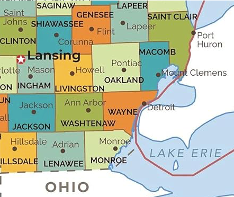
Fig.1: Counties in the state of Michigan which surround the city of Detroit.
The results of the 2024 US presidential elections in these counties, their demographics and basic economic characteristics are summarised in Table 1.
| Detroit Metro Area County | GDP $billion (2023) | Median household income (2023) | Population (2023) | White | Black | Hispanic | Trump | Harris |
| Wayne County | $122.1 | $59,521 | 1,770,000 | 48% | 37% | 7% | 34% | 63% |
| Macomb County | $51.6 | $76,399 | 878,000 | 75% | 12% | 3% | 56% | 42% |
| Oakland County | $137.4 | $95,296 | 1,270,000 | 69% | 13% | 5% | 44% | 54% |
| Monroe County | $8.0 | $75,272 | 155,000 | 89% | 4% | 4% | 63% | 36% |
| St. Clair County | $7.5 | $68,831 | 5,900 | 90% | 2% | 4% | 67% | 32% |
| Lapeer County | $3.1 | $76,228 | 88,700 | 90% | 1% | 5% | 69% | 29% |
| Livingston County | $7.8 | $101,315 | 195,100 | 91% | 0.4% | 3% | 61% | 37% |
Table 1: Trump vote in the Detroit Metro counties and their demographic and economic characteristics
Two features stand out from the table. Trump had his highest vote in the counties with the greatest proportion of White population, Monroe (Trump vote 63%, population 89% White), St. Clair (Trump vote 67%, population 90% White), Lapeer (Trump vote 69%, population 90% White) and Livingston (Trump vote 61%, population 91% White).
Trump lost in the two counties with the highest GDP, those with greatest economic activity, Oakland and Wayne. They also have the lowest proportion of White population. Economic activity rather than income seems to be the greatest driver of the anti-Trump vote. The workers in the most productive areas are the most ethnically and racially diverse. The counties with the second highest median household income, Oakland, and the poorest county, Wayne, both voted solidly against Trump. The pattern had already been noted in the New York case study in the previous post where both the Bronx, the poorest, and Manhattan, the richest, voted heavily against Trump. That Wayne County had a relatively high economic activity, including a relatively high per capita GDP (not shown on the table), but a low median household income is because very little of the GDP went to labour as wages. Most will have gone to capital in the form of profits and rents.
Macomb County is interesting and is recognised by pundits as an electoral bellwether county that has consistently voted for the winner of presidential elections of both main parties. It still contains a significant proportion of blue-collar manufacturing industry workers.
The making of the White Working Class
The overwhelmingly White populations (with the partial exception of Oakland County) of the counties in Table 1 which surround Wayne County, the county that contains Detroit city have been historically constructed largely from the deindustrialisation and depopulation of Detroit, in a process that came to be known as White Flight.
Detroit’s industrial history, and the role played by racism in it, is poignantly told in a remarkable book by Thomas Sugrue, The Origins of the Urban Crisis: Race and Inequality in Postwar Detroit, (Princeton U.P., 1996) from which I have taken much of what follows.
The original industrial working class of Detroit was of European origin. In 1910 Afro-Americans made up only 1.2% of the city’s population. The various European immigrant communities lived largely in geographically separate areas. Prominent among these were the Polish, Hungarian and Jewish communities. The immigrants brought with them the culture they inherited from their origins. That culture was inserted into what had already developed into a specifically American culture, but whose roots were themselves largely European.
The Afro-American population of Detroit was created initially by two Great Migrations, the first that took place between 1916 and 1929, and the second between 1940 and 1970. Between 1910 and 1970, six million African Americans moved out of the rural Southern United States to the urban Northeast, Midwest, and West to escape Jim Crow laws in the South, attracted to jobs in the fast-growing industries in the North where they were employed at the lowest wages. From 1910 to 1930, the Black population of Detroit increased from under 6,000 to over 120,000, as the city developed to become the fourth largest in the country. They settled exclusively in a small area of central Detroit known as Black Bottom. This gradually expanded to what came to be known, somewhat ironically, as Paradise Valley.
Paradise Valley became heavily overcrowded. In the 1940s, the new wave that came to feed the defence industry, into which much of the auto industry had been converted, began to overflow the area. The reaction, in the words of Thomas Sugrue, was
“White neighbourhoods, especially enclaves of working-class homeowners, interpreted the influx of blacks as threat and began to defend themselves against the newcomers, first by refusing to sell to blacks, then by using force and threats of violence against those who attempted to escape the black sections of the city, and finally by establishing restrictive covenants to assure the homogeneity of neighborhoods.”
The arrival of the descendants of slaves from the South in the Great Migrations was generally perceived as constituting an alien threat, both to the economic wellbeing and to the culture of those that by then had developed a collective consciousness as a White working class, and become highly unionised and militant.
Housing became a major issue of contention. The struggle to maintain the racial homogeneity of White working-class neighbourhoods was conducted largely through the mobilisation of workers who were owner-occupiers in the areas where they lived, containing most of the city beyond Paradise Valley. The residents organised themselves in homeowners’ associations. These used all available means, including violence and intimidation both against the newcomers and against the residents willing to rent or sell houses to Afro-Americans. Sugrue points out that
“As improvement associations, they emphasised the ideology of self-help, and individual achievement that lay at the very heart of the American notion of home ownership.” (p.211)
Over time, the white working-class areas lost the boundaries that had existed between the various ethnic communities of European origin and became more homogeneously defined only by their whiteness. The city increasingly gained clear Black-White geographical borders which were militantly defended by white vigilante groups and eventually reinforced by the building of a physical wall, known as the Eight Mile Wall, which kept the races separate.
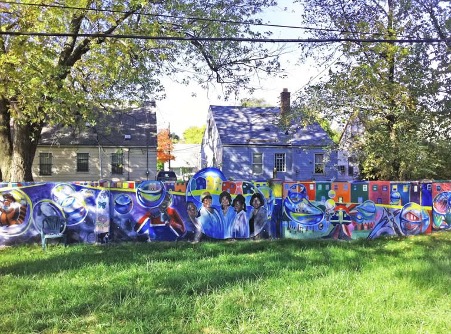
Photo 1: The Eight Mile Wall today
Source: http://www.Blackbottomarchives.com/allaboutdetroit/2016/1/2/detroit-untold-the-8-mile-wall
S
The racial zoning of the city gained official sanction at city and federal level when, during F.D. Roosevelt’s presidency, the federal housing agency, the Home Owners’ Loan Corporation (HOLC) (later to become the Federal Housing Administration) redlined the map of Detroit, and other US cities, to classify the city’s neighbourhoods according to the perceived desirability of their residents according to class and race on a scale of A to D, where A indicated the most affluent and D the most deprived. Areas where people of colour resided were invariably classed as D and their boundaries red lined on the map. HOLC refused mortgages for the purchase of houses in these areas, as the neighbourhoods were deemed as “hazardous” to investment.
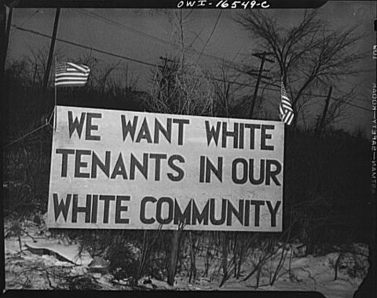
Source: https://en.m.wikipedia.org/wiki/File:We_want_white_tenants.jpg

Racism extended to the factories, where collusion between the White labour force and employers kept Afro-Americans confined to the dirtiest, most dangerous jobs at the lowest wages. This racism was officially opposed by the union, the United Auto Workers (UAW) union, but seldom vigorously pursued. During World War II, there were several wild cat strikes to prevent the move of Black workers into higher wage all-White departments, or to more senior positions. These were eventually suppressed by intervention of the UAW.
Detroit city’s industrialisation and population reached its peak of 1,849,568 in 1950 and has been decreasing ever since. It is now 633,000. Deindustrialisation of the city started in the 1950s Detroit’s motor industry, which was highly unionised and a source of well-paid jobs whose high wages had been the result of trade union struggles, started a dual process of decentralisation and automation. Factories moved first from the city centre to the suburbs and, later, to the Southern states of the US where wages were lower, and labour wasn’t unionised. The new factories had a higher level of technology and productivity. In the 1970s, production started to move also abroad. The decline of the city’s population was largely the result of this process, with White workers moving to the surrounding areas to take up the jobs that were being created.
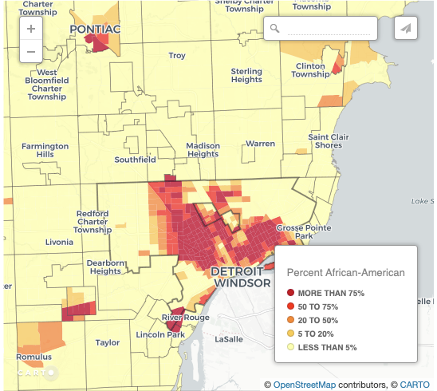
Fig.2: A racial map of Wayne county and surrounding area according to the 2010 census.
Source: https://urbanhistory.willmackintosh.org/project/eight-mile-road-and-the-8-mile-boulevard-association/
But they were also fleeing the encroachment of the growing number of Afro-American workers into their all-White owner-occupied housing neighbourhoods when they failed to contain it. Detroit city is now 77% Black and very poor, and, as Table 1 shows, the surrounding counties are overwhelmingly White. Detroit is today the most racially segregated city in the US.
What happened to the fleeing White Working Class?
Between 1969 and 2000 nearly half of the population loss of Wayne County was made up by gains in Oakland County with most of the rest of the loss being made up in the other four counties. As the Table 1 above shows, Oakland became the most populous county of the metropolitan area, after Wayne whose population nevertheless had greatly decreased. White collar workers tended to migrate to Oakland County, blue collar workers to Macomb County. By 2023, 90% of the population of the metropolitan area was concentrated in three counties: Wayne (41%), Oakland (29%) and Macomb (21%) where most of the economic activity of the area was also concentrated. That population is majority working class in the sense that their income comes largely from their wages. However, the population has very different characteristics in ethnicity, income and ancestry in the different counties.
By 2023, few or none of the original Detroit city industrial workers are still part of the labour force of any of those counties. In Wayne County, where Detroit city is located, the descendants of the original Afro-Americans constitute a large proportion1 (37%), but they have been joined by more recent immigrants from different ethnic minorities (Hispanics constitute 7%) and together they comprise the majority of the labour force. They will have provided the main share of the anti-Trump vote in Wayne County. The descendants of the White industrial workers of Wayne County who have remained in the city will constitute a significant proportion of the current labour force and it is likely that many will be found amongst the 34% of Trump voters.
Comparing the economies of the two suburban counties where most of the economic activity of the region is concentrated, Oakland and Macomb, provides a possible explanation for Trump having lost the first with 44% of the vote, and won the second with 56%.
Oakland County
The initial population of Oakland County grew out of the flight of mostly white-collar workers from Detroit, overwhelmingly White. From the beginning, the educational level of its labour force was higher than that of Macomb County which had received mostly blue-collar workers. Oakland’s economy began to diverge from that of Macomb by attracting industries with a higher level of technology, a process that was aided by county policy to raise the educational level its labour force. Oakland University was created as early as 1957 as an outpost of Michigan State University and became independent in 1970. Eventually it became county policy to attract high technology industry by promoting research and development in the county. The population of Oakland County is now highly educated; 50.2% of adults have a bachelor or higher degree, compared with the US national average of 37.7%. A 2004 report on the Michigan economy by Michigan State University found that Oakland ranked first of Michigan’s 83 counties for knowledge-based jobs, information technologies and overall education of the population.
Oakland County has lost a significant proportion of the original White industrial working class and their descendants. This has been replaced mainly through international migration, greatly increasing the diversity of its population. Oakland has also received in internal migration the descendants of more affluent Black industrial workers of Detroit who gained education and managed to escape the city. In 1970 Oakland was 97% white and 3% Black. In 2023, it was 70.0% White, 13.9% Black or African American, 8.8% Asian, and 5.1% Hispanic. Many of the new arrivals were people with high levels of education. This diversity is likely to increase independently of migration as the proportion of people of colour in the population increases as age decreases.
However, Oakland County is highly racially segregated geographically. For example, the city of Pontiac (see Fig.2 above) has a large concentration of Afro Americans who make up 52% of the population, compared with 34% white. It is a poor city with a median household income of $42,791. In the city’s precincts the vote for Kamala Harris ranged from 52% to 89%.
But the city of Birmingham, also in Oakland County, is 85% white and also voted for Harris by between 58% and 63%. Birmingham has a median household income of $153,125, nearly double the national average. In Birmingham 77.9% of adults have a bachelor’s degree, or higher. Birmingham has 11,243 employed people above the age of 16, of which 7,748 are employed in “Management, business, science, and arts” including 3,926 in “Management, business, and financial occupations”.
Macomb County
Macomb County’s population has retained much more of its original characteristics. Manufacturing industry, with a high proportion of blue-collar workers, is still the economic sector that provides the greatest number of jobs. The county has over 1,600 companies employing more than 72,000 workers. Auto makers General Motors, Ford Motor Co., Stellantis, Magna International, and ZF North America all have factories in the county. The city of Sterling Heights is a major locus of the industry. The population of Macomb Conty has a low level of education, with only 28% having a bachelor’s degree or higher, considerably lower than the US average of 37.7%.
However, the weight of manufacturing in the county’s economy has continued to decline and the relative standard of living of its workers has suffered. The 2008/9 Great Recession had a particularly disastrous impact. Sterling Heights saw a dramatic decrease in annual household income. In 2000 the median income was $77,873 and in 2015 it had dipped to $51,545, a 33.8 percent decrease in nine years.
This was part of a longer-term pattern which affected Metro Detroit as a whole. A 2017 report analysing the changes that had taken place since the results of an inquiry into the 1967 Detroit riots were announced in 1967, found that blue-collar jobs in manufacturing industries in metropolitan Detroit declined from 591,000 in 1970 to 191,000 in 2016, a 68 percent decrease. The average earnings of these workers dropped 25 percent for a variety of reasons, including the declining clout of unions. Earnings had fallen substantially even for those blue- collar occupations that have grown rapidly.
Macomb left behind
The previous discussion indicates that the working class of Macomb County, largely White, voted for Trump’s agenda because it feels itself in decline and left behind. Workers in Oakland County don’t buy into his agenda because they feel part of a progressive economy, The kind of economy being developed in Oakland County has been described as a “knowledge economy”. The source of these relative feelings can perhaps best be illustrated by the following table.
| Detroit Metro Area County | Per capita personal income as proportion of US average | Trump vote | |
| 1970 | 2023 | 2024 | |
| Oakland County | 1.33 | 1.31 | 44% |
| Macomb County | 1.06 | 0.84 | 56% |
Table 2: Detroit Metro counties left behind the US average personal income
The average standard of living of the citizens of Oakland County has just about kept pace with those of the US as a whole. The relative position of the citizens of Macomb County has deteriorated considerably. They are being left behind.
The local impact of US imperial ventures
In the previous sections, I have highlighted the main economic reasons that motivate a vote for Trump, but they are closely intertwined with identity issues of race and nationality. The immigrants who are an integral part of the narrative are foreigners. There is also a constant implicit suggestion in many people’s minds that Blacks are also aliens.
Another aspect of the politics of identity that has influenced the vote for Trump in the region that needs to be highlighted is the way that the US’s foreign imperial ventures have come to impinge on its internal politics.
Arabs in Sterling Heights
Macomb County’s population has become more diversified as Table 1 above shows, but not as much as that of Oakland. In Sterling Heights, approximately 27% of the population is foreign-born. The workforce of Sterling Heights auto plants is no longer entirely white as the photo below taken at a picket line at Stellantis Sterling Heights Assembly Plant during a 2023 UAW strike demonstrates.
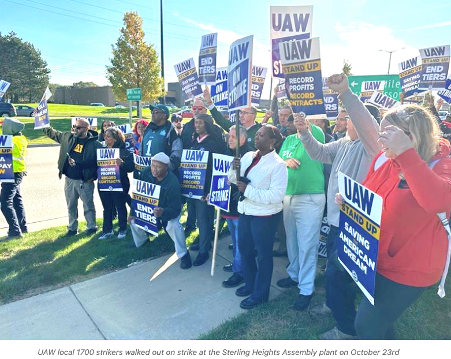
Photo 3: Strikers outsider Stellantis Sterling Heights Assembly plant on 23 October 2023
Source: https://wrp.org.uk/features/6800-uaw-members-at-the-shap-michigan-join-stand-up-strike/
However, racism persists. As recently as 2019, a symbolic noose addressed at Afro-American workers was found hanging in the paint shop of the Stellantis plant.
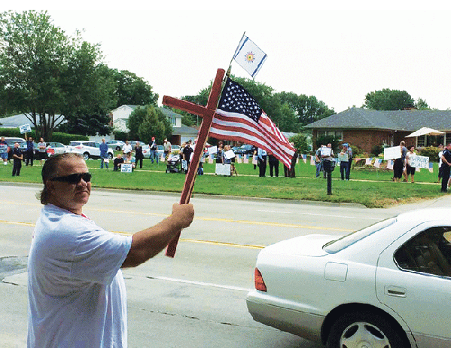
Part of the diversity of the population of Sterling Heights has been the by-product of US imperial ventures. Sterling Heights is home to a large Arab community, mainly of Iraqi origin, which grew greatly when refugees from the George W. Bush’s 2003 invasion of Iraq settled there to join the existing small Arab community. Michigan has a large Arab community dating back to the end of the 19th century when Lebanese and Syrian Christians began to settle there. It grew at the beginning of the 20th century when Henry Ford started to recruit workers in the Middle East for its Detroit factories.2 The Arab population in the US has been considerably swollen by refugees from US’s foreign wars. The contradictions this generated in internal US politics soon began to make themselves felt. Islamophobia in the US greatly increased after the 7/11 Twin Towers attrocity. In 2015, a proposal to build a mosque in Sterling Heights was the object of a number of militant demonstrations by local residents to try to stop it. The city planning commission voted against it, after the mayor joined the objectors. The city decision was eventually changed by federal intervention and the mosque was built.
Source: https://arabamericannews.com/2015/09/04/sterling-heights-mosque-controversy-spills-across-chaldean-and-muslim-communities/
There is nothing more symbolic of identity issues affecting the vote for Trump than the above photograph.
Conclusions
I set out to undertake the research that led to these blog posts on the social base of Trumpism seeking mainly to confirm the hypothesis that I have been putting forward in previous posts that a base to fight back against the rise of fascism in Western societies exists but has not been recognised. I have called this New Working Class. They are the multicultural and multiethnic workers that have been the main driving force of the economies post-industrial countries, a force that has been created over a relative short time, largely as a result of post-World War II immigration and that has settled primarily in the main metropolitan centres. Their locus and antifascist political consciousness can be identified in elections where the far right and neofascist forces have made significant advances by pinpointing the areas where the strong anti-right vote is and the characteristics of that electorate.
Bifurcated labour force
Post-industrial economies have developed a bifurcated productive labour force, both branches of which have become highly dependent on foreign immigrant labour. On the one hand, there are the so-called “knowledge jobs” which underpin innovation, the high technology and creative industries, the main drivers of economic growth. They required a high level of education and are well paid, but they are also highly pressurised and subject to a high level of management control, with little autonomy. Much of the control of their labour is achieved through algorithms built into computer systems. A recent Financial Times article discusses a survey of such workers and bemoans the fact that “in 1992, 62 per cent of surveyed workers said they had a great deal of task discretion. By 2024, only 34 per cent said the same”.
The other growth branch of the labour force is in very low paid work carried out in precarious circumstances, in health, social care and service industries like cleaning, tourism and food and distribution. Many, particularly in health and social care, require considerable skills but are paid as unskilled.
Both branches supply productive workers
In the cases studies carried out in these posts, I have confirmed that both branches vote in great numbers against Trump. In New York, the highest anti-Trump vote was in Manhattan where the first group of workers are concentrated and, in the Bronx, which is home to the second branch. In the Detroit Metro region, the anti-Trump vote was concentrated in 77% Black and poor Detroit city, on the one hand, and in Oakland County, an exemplar of the first branch. Most notable of all was the anti-Trump vote in Birmingham city, Oakland County, where the median household income is 50% higher than in Manhattan.
The anti-Trump vote by those I have placed in the first branch of the labour force has been widely noted in the media but has been characterised as being a vote of the educated middle classes. A recent The Economist article (31st May 2025), brought to my attention by my friend and colleague Richard Sharpe, satirises the trend with an article titled Doctors, teachers and junior bankers of the world, unite!. But what my case studies have shown is that it is their labour that powers the post-industrial economy and provides capital with its profits. In that sense, they are the most productive workers, and that label might describe them better than that of “middle class”.h
Collective and individual psychologies
The other important insight that might be derived from the Metro Detroit case study analysed in this post, is the way that the economy and culture interact historically to frame and help shape collective and even individual psychology. National identity is an example of collective identity, as is class, gender and race consciousness. But the act of placing a vote in representative democracy election is an individual one, carried out on the basis an individual psychology that has been framed by multiple collective ones. Statistical trends help us identify which of the multiple collective identities have been most influential. The statistical analysis carried out demonstrates how important the concept of White race is in the Trump vote, nationally and even more in post-slavery and Rust Belt states.
The narrative developed in this series, but most of all in the Detroit case study, has demonstrated how the development of personal identity with the nation is a complex process, but requires that the nation provides the individual with the sense that progress of the nation will lead also to progress of the individual. In imperialist countries, the economic progress of the nation has been achieved on the basis of imperial economic exploitation. That growth has historically benefitted both capitalists in the form of greater profits and workers, in the form of higher wages, thus creating a material basis for a common identity with the nation. Imperialism is therefore essential to underpin the sense of national identity across classes in such nations.
Migration
Migration is process by which individuals seek to improve their position. Migrant workers remain in the country to which they migrated because they feel their life there is better than the one that they left behind. There is a sense of personal progress, even when the jobs performed are menial and much more poorly paid that those done by native workers. Over time, they and their descendants come to acquire the host country’s national identity as long as that sense of progress is maintained. Migration is by its nature an individual act and creates little in the way of collective identity. Migrants’ collective identity as a separate group within the host country is the one they brought with them from the home country. The Detroit case study shows that the White working class of Metro Detroit was created largely from European migration, and migrants initially created geographically separate communities according to their original collective national identities. However, over time, the differences between the various European national identities largely subsided, and became submerged in a collective American identity. What remained was a common White identity formed by a common European culture, itself partly a product of previous European imperialism. Their consciousness was reinforced by opposition to the racial other, the descendants of African slaves in the United States which Europe had always labelled as savages. This constituted a sort of moral justification for the atrocities of European imperialism.
The Black working class of Detroit was created by the migration of Afro-Americans from the South to escape the Jim Crow post-slavery society still prevalent there. Their miserable existence in Detroit was felt to be better than the one they left behind. The Black migrants were perceived as competitors for jobs with the resident labour force of European origin, a hostility that was reinforced by the cultural stereotypes that had been inherited from Europe.
But Detroit was throughout the first half of the 20th century a powerhouse of the US economy and a main provider of goods to the US empire, from which both the White and the Black working classes benefitted, albeit to widely different extents. This kept the tensions within the working class within limits and fostered a fragile degree of common trade union consciousness against the bosses. The common imperial interest with the bosses kept the class struggle under control and reinforced national identity. The Afro-Americans of Detroit developed a lively cultural life of their own and provided, through Motown music, a major contribution to US and world culture.
Deindustrialisation from 1950s onwards began to unravel all the compromises that had been achieved and unwittingly started the process that eventually led to declining US world dominance and the current crisis.
The universal recognition that Trumpism is a symptom of a nation totally divided and in crisis, has led to a frantic search by the political centre ground for formulas that will “bring the nation together again”. This is patently impossible in the absence of the economic growth that had been underpinned by imperial might. This is what Trump is intent on restoring, politically mobilising a base by appealing to an inherited cultural sense of national identity.
However, the potentially insuperable obstacle he faces is that to achieve his purposes he has demonised as the internal enemy, and the foreign enemy’s Trojan horse, the very workers who are currently powering the economy, those I have collectively labelled as the New Working Class. If they become conscious of their power and mobilise, Trump will face a real opposition which the hand-wringing puzzled liberals are unable to provide. It is, however, undoubtedly a big IF…
That Afro-Americans make up 77% of the population of Detroit city, but only 37% of the population of Wayne County, which contains the city, shows that Wayne County’s population outside the city is overwhelmingly White. ↩
In 2019, Michigan elected Detroit-born Rehana Tlaib, daughter of a Palestinian immigrant worker on the assembly line of the Ford plant in Detroit, as a Democratic Party representative to Congress. She is a member of Democratic Socialists of America and became part of the progressive caucus known as the “awkward squad”. ↩