Harold Wilson is reputed to have said once that a week is a long time in politics. The last week certainly has been a quite momentous one for Left politics in both the US and the UK.
Two country stories, one set of issues for the Left
On the 1st July, Zohran Mamdani, a self-identified democratic socialist, won the Democratic primary nomination for the forthcoming election for Mayor of New York on a platform, as many commentators stressed, focussed “laser like” on class politics around the central theme of increasing the affordability of essentials for workers. Mamdani is a Muslim American, born in Uganda to a couple of Indian origin. His mother is the well-known Indian filmmaker Mira Nair, director of popular films such as “Salaam Bombay!,” “Mississippi Masala” and “Monsoon Wedding,” of Punjabi Hindu descent. His father is Mahmood Mamdani, Herbert Lehman Professor of Government and a professor of anthropology, political science and African studies at Columbia University: He was born in Bombay, India, of Muslim Gujarati parents. His success caused huge distress to the Democratic party establishment and to Wall Street. Wall Street had bankrolled his opponent, Andrew Cuomo, former Governor of New York State, who had resigned in disgrace facing the possibility of criminal charges, to the record-breaking tune of $25 million.
On the same day, Sir Keir Starmer and Rachel Reeves’ Welfare Reform Bill, whose main aim had been to reform welfare to save the Exchequer $6.25 billion pounds mainly by cutting the costs of welfare payments to disabled people, passed its first reading in the UK’s House of Commons. But this was a bill that had been gutted of much of its proposed savings by concessions to Labour MPs in revolt. As a result of the concessions, $5 billion had gone and Rachel Reeves was left expecting savings of “only” $1.25 billion and in tears in the Commons when Keir Starmer failed to fully back her.
I have been arguing in this blog that the Left needs to analyse politics comparatively and in the global context. This is what I intend to do here. The point of juxtaposing the two stories is manifold. Together they throw light on debates on the Left on the relative merits and roles of class and identity electoral politics. Analysis of the stories also demonstrates the way that, in the current circumstances of economic stagnation and rising inequality, politics is more than ever shaped by the relative economic interests of capital, for whom maintaining profits is paramount, on the one hand, and of workers who increasingly feel it difficult to fulfil their basic needs, on the other. These issues are not national in nature, but common to all capitalist nations where governments are elected.
The issues raised by the events also allow us to reflect on the central problems that face Left politics: (i) is our task the reduction of inequality nationally or globally? (ii) is the reduction of inequality at the national level possible by purely electoral means? (iii) what is the relation between the two sets of inequalities and is it possible to reduce inequality at the national level without it affecting international inequalities, or reducing them at the same time?
US leads the way for class-based politics
Mamdani’s Left critique of the politics of the Democratic establishment is that its adoption of identity politics focussing on issues of race, gender and sexuality sows divisions amongst the victims of capitalism, but a “laser like” focus on bread-and-butter issues will unite them and undermine the divisions that the culture wars foment. Together, working class voters constitute the majority of the electorate and such appeal will win elections. Presenting Hilary Clinton, Kamala Harris, (or Rishi Sunak, Kemi Badenoch, Suella Braverman, for that matter) as victories of antiracism and feminism, is a gift to Trump (and Farage), for in their campaigns they point to the fact that these women and men of colour are part of the elites and are climbing the social and economic ladder because of “wokeism”, preferential treatment based on their identities, whilst the working class who don’t fit that bill continue to linger in poverty, ignored and left behind. Therein lies the power that the charge of wokeism has in culturally mobilising the white working class.
Starmer as the Standard Bearer of the Establishment Left
On the other hand, Democratic and Labour Party establishment politics is based on the dual premise that winning elections must be done by appealing to voters on the centre ground and, having won them, governing successfully requires making compromises with capitalists in order not to frighten them too much, or else they will go on strike and the economy will collapse. Governing is the art of what Trump would call “doing deals”. For establishment politics, panic is being created because it appears that the centre ground is collapsing and politics is being polarised. It is becoming increasingly difficult to win elections on the centre ground. Left establishments feel forced leftwards in order to be able to justify their label and their self-image as Left. The panic is enhanced by knowing that moving politically Left will lead them to lose the financial support which fuels their election campaigns, and the personal opportunities they provide. No more Rolex watches, designer suits, free trips to the opera, premier league matches in executive boxes, or company directorships and lucrative lecture tours to business audiences in their post-political careers. They blame what they see as the problem on an ill-defined “populism” that is undermining the very core of their politics.
But they are also aware that if electoral programmes promise workers too much on elections, as they fear class warriors are urging them to do, doing deals with capital in government will become much harder. Previous experience of government tells them that. In this they are absolutely right, and it will be a problem for class-based electoral politicians, should they prove successful in winning elections. I will return to this later.
Everyone agrees that Starmer won last year’s general election on a centre ground platform mainly by default, because of the collapse of the Tories. There was little enthusiasm for Starmer and for Labour on the part of the electorate, far less than the enthusiasm that Corbyn had generated in the 2017 election when, where I live in Lambeth, many Labour posters appeared in house windows for the first time in decades, and he won more votes nationally than Starmer in 2024.
The relationship between economic growth and redistribution
However, Starmer’s 2024 Labour election manifesto was based on a premise that is entirely correct. Without economic growth, doing deals with capital in government and simultaneously fulfilling campaign promises to workers will be impossible. So, the top priority has to be achieving growth.
The Government felt that they had to show early on that they were capable of fulfilling promises in order to try to counter as soon as possible the general scepticism that politicians promise and don’t deliver. So, it opened its legislation with an Employment Rights Bill which clearly favoured workers, even though it did little to restore what had been lost since 2009 and, arguably, since 1980. Amongst its measures, it put up employers’ contribution to National Insurance.
I have been following in the FT the outrage that has been expressed by the bosses at this. The FT sees it as the main cause for the decline in the capital investment that is needed for economic growth, and for the poor performance of the economy. This is reflected in the FT articles analysing the debacle of the passage of the Welfare Reform Bill through the Commons in a way that I will now demonstrate.
What prompted me to write this post was reading two articles in the Financial Times discussing the political and economic implications of Starmer’s climb down over the Welfare Reform Bill in a way that seems perfect to illustrate the reality of politics as mainly structured by the relative economic interests of capitalists and workers. This is the main point of what follows.
What “the markets” want and how they fight
The FT dedicates an editorial on its July 2 issue to the Welfare Reform Bill climbdown in which Starmer is demolished, and told he has to carry the blame for all aspects of the disaster. Following the passage of the Bill, Rachel Reeves was shown in tears. Journalists, commentators and financial markets had ascribed this to Starmer not having roundly supported his Chancellor in his Commons intervention and having left the impression that she might be due for the chop.
On seeing this, the stock market immediately reacted. The value of the pound plummeted – wiping £3billion off markets in a short space of time.
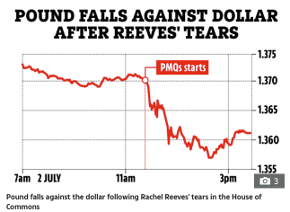
The FT editorial says that this is “because investors are antsy that any successor to Reeves would loosen fiscal rules”. What the FT doesn’t say, is that this fear of investors isn’t so much because of the economic damage that increased government debt caused by increased borrowing would create. That was the way all mainstream media present the story. It is more because any increased borrowing would give the government the room to deliver to workers what it had promised. Failure to express immediate unconditional support for Reeves raised the probability of further concessions to workers’ rights that would dent their profits in the absence of growth. This has been the main cause of the market reaction.
Presenting Rachel Reeves as the “iron chancellor” wedded to her fiscal rules was the means by which Starmer and the government hoped to ensure that its election would not be immediately followed by a collapse of the stock market and a run on the pound. The FT editorial further blames Starmer for not having been aware that benefit cuts would be like a red rag to a bull to Labour MPs and so made him responsible for the internal crisis in the party, as well as its economic effect. He also had done another U-turn, thereby losing any authority he had over the party and its MPs. The FT clearly sees Starmer’s days as numbered.
An accompanying comment article by Robert Shrimsley (Crying for a lost Labour government) in the same issue pulls no punches, saying:
“The first anniversary of Labour’s victory has been marked by a self-inflicted shambles which has shredded the authority of both Keir Starmer and his chancellor and which culminated in ministers driving through a welfare reform bill so gutted of content that it no longer saves any money. Reeves took a hard line in pressing for cuts and must own her share of this.”
The article is illustrated by an arresting symbolic image of Reeves which copyright prevents me from showing, but is worth seeing, hopefully here:
https://ft.pressreader.com/article/281878714374419
Zohran Mamdani’s electoral success
Zohran Mamdani’s success in the New York Democratic primary for Mayor constitutes a considerable vindication of the argument that class-based programmes aimed at winning the votes of all workers who increasingly feel that they can’t make ends meet (living from paycheck to paycheck in the refrain of Bernie Sanders) is the way to win elections in the current situation. The distress (a lot of the US media call it panic) of the Democratic establishment is that this demolishes everything they have believed in about politics since Bill Clinton won the party over to Third Way triangulation thinking.
The other aspect of Mamdani’s campaign that challenges establishment thinking is that it was based on generating enthusiasm amongst the youth. This enables an army of volunteers to be built and brings in millions of dollars in funds in the small donations, many individual. The money is used to support the activities of volunteers and on social networks, including the production of short videos directed at young voters. Establishment Democrats rely on SuperPACs funded by big business and use the money generated mainly to pay for professional mainstream media advertising read and viewed, mainly by well-off, older voters, a fast-declining voter demographic.
The electoral success of class-based politics is an indication of the breakdown of compromise that has existed between capital and labour. This is what underpins the concept of the ‘national interest’ based on negotiating the division of the spoils of empire between them.
Capital v. Labour shapes politics
The crisis of the Starmer government in the UK shows how the absence of any “spare money” created by economic growth makes “the markets” feel very threatened by any attempt to benefit workers. They then mobilise strongly against the measures. The markets are all powerful in the absence of countervailing social mobilisation which might be perceived by them as an existential threat to the system. Such social mobilisation might bring some significant concessions.
The revolt of Labour MPs might have prevented the damage to ordinary people’s basic needs from being even greater, but the “iron chancellor” stays and so do her fiscal rules which protect the interests of the market. The can of economic worms is kicked down the road to be dealt with at the next crisis.
The success of class-based politics is problematic
The issue facing a Left riding the wave of electoral success for class-based politics is: how would they deal with the problems faced by the Starmer government if they win power? The market reaction they face would be much worse. There have been suggestions that Wall Street will threaten to move out of New York if Mamdani becomes Mayor.
In 2017, it briefly appeared possible that a Jeremy Corbyn-led Labour Party might win a general election. In that event, the run on the markets and the collapse of the pound would occur even before the government was installed and capital would immediately call a general strike of investment. Would Corbyn have a strategy to face this? I doubt it. John McDonnell’s courting of the City in the run up to the election might suggest that in the end a Corbyn government might feel forced to doing deals with it.
The idea that significant change can be achieved by purely electoral means at the national level therefore seems to me unrealistic, to say the least. The Mamdani campaign is conscious that success in current circumstances depends on mobilisation of the base beyond the ballot box. This Trump has demonstrated better than anyone else. It is possible that Mamdani will try to maintain this strategy beyond the election, if he wins, but will that be enough?
An internationalist strategy for the Left
The Rachel Reeves/Starmer House of Common episode demonstrates that the power of the markets lies in that they operate globally, and the effect of their actions is felt locally almost instantaneously. Unless the Left likewise learns to view the development of its electoral politics as one important element of a broader strategy that takes into account the international context and develops links with likeminded movements elsewhere that can be mobilised in support if it is electorally successful in a particular country and faces a confrontation with the markets, little can be achieved and it will be swept out of power.
I began to develop this view thinking about the Greek crisis of 2015. Then, a radical Left Syriza government led by Alexis Tsipras, extremely popular with the Greek people, confronted a Troika made up of the European Commission, the European Bank and the IMF. The Troika was trying to impose austerity on the Greek government so that the Greek people rather than “the markets” would carry the main burden of the economic crisis. The Syriza government and the Greek people had a broad base of sympathy and popular support throughout the European Union and beyond. An internationally conscious European Left could have made support for the Greek people its primary task and mobilised to great effect. It could have frightened the Troika sufficiently to wring enough concessions and kept Syriza in power. It would have achieved at the same time a major change in the Left/Right balance of power throughout Europe.
Instead, the Left in every EU country remained focused on their own national problems, worried about their electoral prospects. The Greeks were left to fight largely alone and Tsipras and Syriza were defeated. They, mainly Tsipras, were left to carry the blame for that defeat, very unfairly in my view. The blame lies mainly with the European Left. Tsipras and Syriza put up a brave fight and were defeated for lack of international support.
Alvaro de Miranda
Alvaro de Miranda
Alvaro de Miranda is retired from the University of East London where he co-founded a Department of Innovation Studies. He came to the UK in 1958 aged 15 to join his parents who were exiles from the Salazar regime in Portugal. Having experienced fascism, he is particularly alarmed with the recent worldwide electoral rise of the far-right and has been following it comparatively in this blog.